
Planning travel to Manila? Speak with a security consultant.
Manila is the capital and commercial centre of the Philippines, a significant regional business hub, and one of the more security-intensive operating environments in Southeast Asia for corporate travellers. The kidnap-for-ransom threat, armed robbery, and the regional terrorism profile of the southern Philippines create a security requirement that goes well beyond standard travel precautions.
The security landscape
Kidnap-for-ransom is the defining threat for corporate security planning in Manila. Criminal operations target both foreign nationals and wealthy Filipino business figures across Metro Manila. The typical operation involves surveillance of the target’s routines before an attempt. Predictable movements, displayed wealth, and unofficial transport are the primary risk factors.
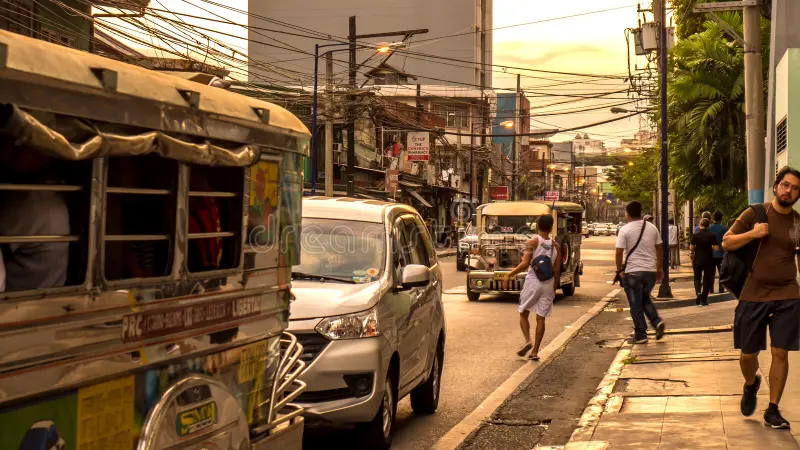
OSAC rates Manila’s crime environment as critical. Armed robbery operates at high frequency across the metro area: jeepneys, buses, and private vehicles at traffic lights are all documented target categories. Firearms are widely available in the Philippines and commonly used in robbery incidents.
Separately, Abu Sayyaf Group, IS-Philippines, and Bangsamoro Islamic Freedom Fighters maintain active operations in the south. The FCDO advises against all travel to western and central Mindanao and the Sulu archipelago. Groups have conducted bombings in Metro Manila, and the December 2023 attack during a Catholic mass in Marawi (4 killed) confirmed continued intent.
Makati and BGC: the corporate operating perimeter
The standard approach for corporate visitors to Manila is to concentrate activity within the Makati CBD and Bonifacio Global City (BGC). Both districts have considerably higher security infrastructure than the wider metro area: international hotel chains with professional security management, good CCTV coverage, active policing, and a population that includes a significant international business community.
This does not mean Makati and BGC are without risk. Armed robbery incidents have occurred in both. The approach reduces exposure, it does not eliminate it. For movements outside these districts, and for any evening or night travel, close protection officers are the standard recommendation. The Manila travel safety guide sets out the pre-trip checklist, transport and accommodation choices, and emergency contacts for a business visit.
Counter-kidnap planning
Kidnapping is a plannable threat. The surveillance that precedes an operation creates observable indicators. Our operators are trained in surveillance detection, route variation, and counter-kidnap vehicle protocols. The critical variable is predictability: kidnap teams rely on predictable routines to identify the optimal interception point. Varying departure times, routes, and venue selection disrupts this planning cycle.
Our Manila risk assessment provides current threat scoring and zone-specific guidance. For regulatory background on the Philippines security industry, see our Philippines security regulations guide.
Our operations in Manila
Our operators work through agencies holding a PNP licence to operate under RA 11917, the Act that repealed RA 5487. Armoured vehicles (B4 and B6 level) are available for elevated-risk assignments. All Manila assignments include counter-kidnap briefings and a venue advance assessment for each location on the itinerary.
Source: FCDO Philippines travel advisory (April 2026). OSAC Philippines Country Security Report 2025. Republic Act 11917 (2022), which repealed Republic Act 5487, checked 7 October 2026.
What are the main security threats in Manila?
Kidnap for Ransom
The Philippines consistently records some of the highest kidnapping rates in Southeast Asia. Criminal kidnap-for-ransom operations in Metro Manila target foreign nationals and wealthy Filipino business figures. Abu Sayyaf conducts terrorist kidnapping primarily in the south, but criminal operations are active across the metropolitan area.
Armed Robbery
Armed hold-ups occur across Metro Manila, including in commercial and business districts. Jeepneys and buses are targeted by armed gangs. OSAC rates Manila's crime environment as critical. Firearms are widely available and commonly used in robbery incidents.
Terrorism
Abu Sayyaf, IS-Philippines, and Bangsamoro Islamic Freedom Fighters operate in the south. The FCDO advises against all travel to western and central Mindanao and the Sulu archipelago. Groups have demonstrated intent to attack Manila: shopping malls and transport hubs are assessed as the primary urban target categories.
Traffic Congestion
Metro Manila has some of the worst traffic congestion in Asia. Extended journey times at predictable intervals create vulnerability windows during vehicle movements. Route variation and traffic intelligence are operational requirements, not optional extras.
Political Violence
Large-scale demonstrations occur periodically in Metro Manila and can turn violent. Drug war operations continue to generate incidents. The FCDO notes that large-scale demonstrations are expected in the capital.
Vetted operators with direct experience in Manila
What security services are available in Manila?
Close Protection
Close protection officers from PNP-licensed agencies with Metro Manila operational experience. Any armed element is agreed only where RA 11917 allows it.
Executive Protection
Full executive security including advance work, armoured vehicle support, and counter-kidnap protocols.
Security Drivers
Anti-kidnap trained drivers with real-time route intelligence across Metro Manila.
Armoured Vehicles
B4 and B6 armoured vehicles available for elevated-risk assignments and UHNWI principals.
What are the rules for private security in Manila?
Key regulatory requirements for operating security services in Manila.
Firearms Policy
Under section 10 of Republic Act No. 11917, a licensed agency may hold small arms, no more than 1 for each security professional it employs, in line with Republic Act No. 10591. Its officers may carry them only on duty, in uniform and within the compound of the establishment they guard, except when escorting large amounts of cash or valuables. Ask how any armed element of a detail fits these rules before it is agreed.
Licensing
Republic Act No. 11917, the Private Security Services Industry Act, lapsed into law on 30 July 2022 and repealed Republic Act No. 5487. The Chief of the Philippine National Police issues each agency's licence to operate (LTO), valid for up to 5 years, and each security professional's licence to exercise security profession (LESP), valid for 5 years. The PNP Civil Security Group's Supervisory Office for Security and Investigation Agencies (SOSIA) supervises agencies and guards. Ask for both licences before an assignment starts.
Foreign Operators
Section 4 of Republic Act No. 11917 allows only Filipino citizens, or entities wholly owned and controlled by Filipino citizens, to organise a private security agency, and a security professional must be a Filipino national. A foreign officer cannot hold an LESP. Use a licensed Philippine agency for protective work, and take local legal advice before a foreign team carries out protective duties.
Sources, checked : Republic Act No. 11917, The Private Security Services Industry Act (Senate of the Philippines); Journal News, PNP-CSG and SOSIA watch private security agencies for gun ban breaches (1 April 2025).
Which areas of Manila carry elevated risk?
Lower-Risk Areas
- Makati CBD: Primary financial and business district. Dense security infrastructure, international hotels, lower crime profile relative to the metro average.
- Bonifacio Global City (BGC): Modern planned district in Taguig. Good security infrastructure, major international brand presence, active street-level policing.
- Ortigas Centre: Established secondary business district. Exercise standard precautions outside office hours.
Elevated-Risk Areas
- Tondo: One of the densest urban areas in Southeast Asia. No corporate itinerary requires access.
- Quiapo and surrounding districts: High petty crime and robbery risk, especially at night.
- Manila CBD after dark: Reduced security presence after business hours. Armed robbery risk increases substantially.
Deploying to Manila? Get a vetted close protection detail.
Request ConsultationWho do you call in an emergency in Manila?
Emergency
911
Police
117
PNP Manila
(02) 8523-9911
Makati Medical Center (2 Amorsolo Street, Makati), 24-hour hotline
+63 2 8888 8999
St Luke's Medical Center, Global City (Bonifacio Global City), emergency care
+63 2 8789 7700
St Luke's Medical Center, Quezon City (279 E Rodriguez Sr Avenue), emergency care
+63 2 8723 0101
Ambulance via national emergency number (ask for an ambulance)
911
US Embassy Manila, duty officer (out of hours)
+63 2 5301 2000
What travel advisories apply to Manila?
- Kidnap-for-ransom is a real and active threat in Metro Manila. Maintain a low profile, vary your routines, and ensure your movements are known to a trusted contact at all times.
- Do not travel to Mindanao or the Sulu archipelago without specialist security arrangements. The FCDO advises against all travel to western and central Mindanao. These restrictions reflect active terrorist kidnapping operations targeting foreign nationals.
- Traffic congestion creates predictable movement windows that criminal and kidnap planning operations exploit. Route variation is an operational necessity. Brief your driver before every journey.
- Use only pre-arranged transport. Taxi drivers and accomplices have robbed and harmed passengers. Reputable rideshare services are an acceptable alternative within the business districts.
- Brief all members of your travel party on kidnap protocols before departure. In the event of an incident, compliance and maintaining communication are the standard initial responses.
Frequently Asked Questions
Is Manila safe for business travel?
What is the kidnap-for-ransom risk in Metro Manila?
Do I need an armoured vehicle in Manila?
Is it safe to travel elsewhere in the Philippines for business?
What security measures are standard for corporate visits to Manila?
This page is published by CloseProtectionHire.com and written to editorial standards overseen by James Calloway, Senior Security Consultant (regulation, licensing, vetting and risk frameworks) and Marcus Webb, Security Operations Adviser (operational close protection, secure transport and city-specific safety).
Threat, regulatory and emergency information is sourced to named, dated authorities such as the FCDO, the US State Department and national licensing bodies. Last updated . See how we verify.