
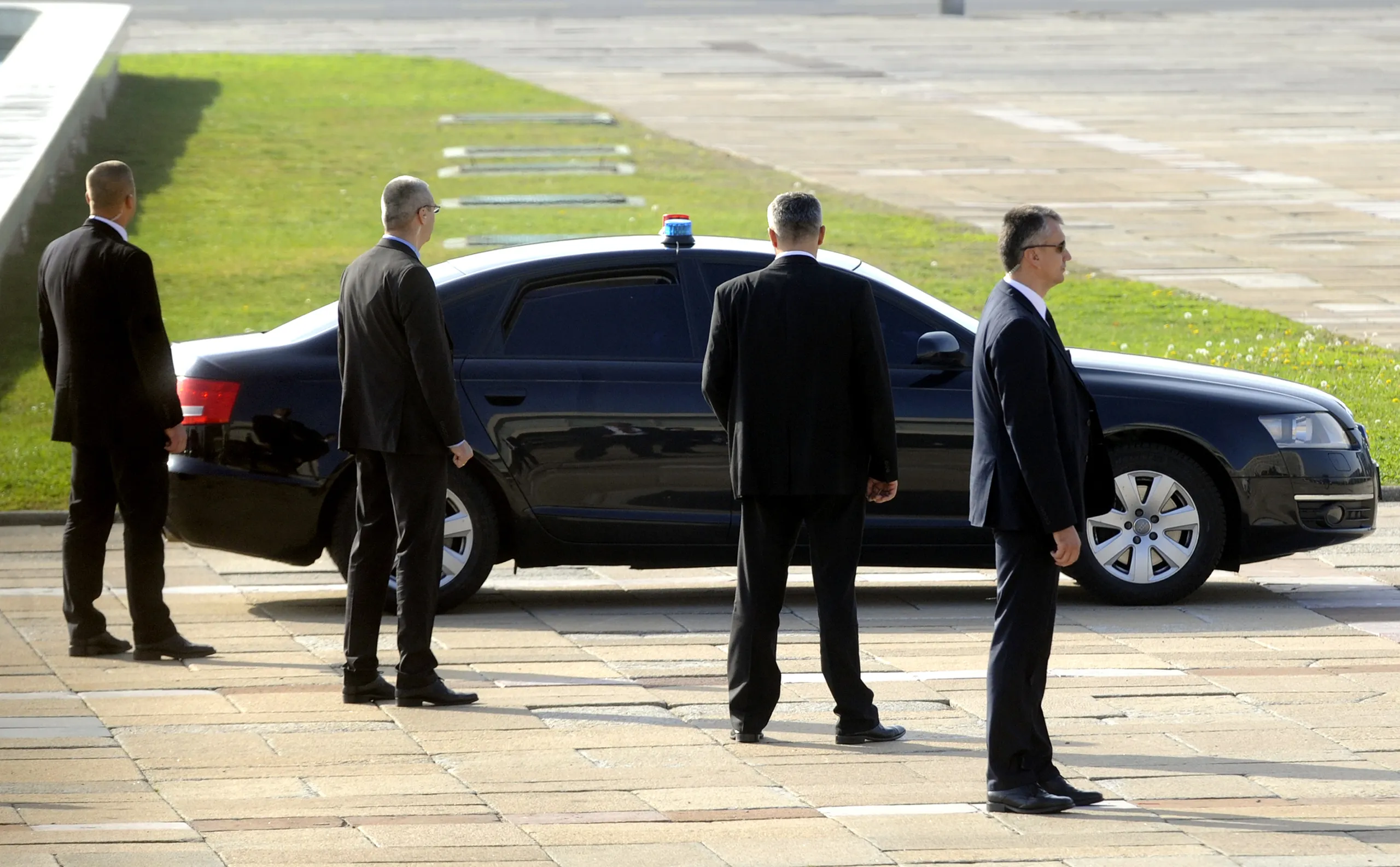
Visiting Quito? Request a vetted security driver for your visit.
Security drivers in Quito solve the single most exposed part of any visit: the journeys. Ecuador’s crime rise since 2022 is expressed largely through vehicles and transport, carjacking and hijacking on the roads, and express kidnappings staged through informal taxis and unverified ride-shares. A vetted driver with a pre-positioned car, a planned route, and an operations controller on the other end of the phone is the direct answer to that pattern, and the FCDO-documented standard for the city. Source: FCDO Ecuador travel advice (2026).
From Mariscal Sucre to the northern corridor
The first journey sets the tone. The driver is inside the arrivals hall at Mariscal Sucre International before the principal clears immigration, holding a pre-agreed identification protocol, with the vehicle staged for immediate departure. The transfer runs directly to La Mariscal, Gonzalez Suarez, or Cumbaya without intermediate stops. The operations controller tracks the flight, the pickup, and the run in, and calls the journey complete only on confirmed arrival. What each of those districts offers, and which parts of the city the route deliberately avoids, is detailed in our Quito city briefing.
Roads, blockades, and the shape of Ecuadorian risk
Quito’s road risk is not only criminal. Indigenous-led protest movements have blocked major highways into the capital with limited warning, so a competent driver operation treats route intelligence as a daily product: which corridors are open, where demonstrations are forming, and which alternates are viable at current traffic. Movements beyond the capital, toward provinces where the FCDO advises against all but essential travel, or to Guayaquil, need a separate route assessment; the national picture is summarised on the Ecuador country page.
Drivers as the base layer, not the whole answer
A driver protects the journey. For principals who also need protection between the car and the meeting room, bodyguard hire in Quito adds an armed, registered officer to the same movement plan, and dedicated arrival cover is described under secure airport transfers in Quito.
What does this cover in Quito?
Mariscal Sucre Arrival Protocol
Transfers from Mariscal Sucre International Airport begin inside the terminal: the driver meets the principal in arrivals with the vehicle pre-positioned, so there is no unescorted wait at the kerb and no negotiation with touting drivers. Because crime in Quito rises sharply after dark, night arrivals run a tightened version of the same protocol, with the operations controller confirming wheels-down and adjusting the pickup in real time.
Driving Against the Carjacking Pattern
Armed robbery, carjacking, and vehicle hijacking have all increased across Quito since 2022, concentrated in peripheral and commercial districts. Driver tradecraft answers that pattern directly: doors locked and windows up for the whole journey, spacing maintained at junctions to preserve an escape line, and no stationary exposure at unmanaged locations. Source: FCDO Ecuador travel advice (2026); US State Department Ecuador advisory (2026).
Why Informal Taxis Are Off the Table
Virtual kidnapping and express kidnapping in Quito have been facilitated through informal taxis and unverified ride-share drivers, which is why the FCDO-documented standard is pre-booked, vetted transport only. Every driver in the Quito network is identified to the client in writing before travel, with police clearance and a valid commercial licence on file, so the person opening the car door is never a stranger.
Routing Around Highway Blockades
Indigenous-led protests in Ecuador have blocked major highways, including routes into Quito, sometimes at short notice. Journey planning therefore always carries a primary and a secondary route, and the operations controller watches the protest picture on the morning of movement. If a corridor closes mid-journey, the driver diverts on a pre-agreed alternate rather than improvising through unfamiliar districts.
Vehicles That Work at 2,850 Metres
Quito's altitude of roughly 2,850 metres measurably affects vehicle performance, particularly on the climbs in and out of the valleys. Fleet selection and journey timing account for reduced engine output, and hill routes to destinations such as Cumbaya are planned with margin rather than driven against the clock.
The No-Go Map
The driver network holds a current picture of where movements do not go: La Marin and south Quito, where gang activity is concentrated, the high-theft areas around the bus terminals, and discretionary night journeys anywhere in the city. A request to a non-standard district is not refused outright; it triggers an advance route assessment before the journey is accepted.
Sources for this page
Licensing, firearms and foreign-operator rules for Quito, checked : Ley Orgánica de Vigilancia y Seguridad Privada, Registro Oficial 496, 9 February 2024 (gob.ec); Ley Orgánica de Vigilancia y Seguridad Privada, full text (gob.ec). The full rules are on our Quito security overview.
Travel advice quoted on this page: FCDO travel advice: Ecuador; US State Department travel advisory: Ecuador. Advice changes; read the current version before travel.
Frequently Asked Questions
Why are security drivers in Quito the minimum baseline for business visitors?
How do drivers reduce express kidnapping risk in Quito?
What happens if a protest blocks the route into Quito?
Are night transfers from Mariscal Sucre airport available?
This page is published by CloseProtectionHire.com and written to editorial standards overseen by James Calloway, Senior Security Consultant (regulation, licensing, vetting and risk frameworks) and Marcus Webb, Security Operations Adviser (operational close protection, secure transport and city-specific safety).
Threat, regulatory and emergency information is sourced to named, dated authorities such as the FCDO, the US State Department and national licensing bodies. Last updated . See how we verify.