
Request a tailored EP programme for Conakry today.
Executive protection in Conakry is a programme, not a single officer. It is the discipline a company applies to protect a travelling executive against political instability under military rule and armed-robbery risk: advance work on venues and routes, a written threat assessment, an operations controller, and an established local operator’s secure transport integrated with the corporate itinerary. This page is for security managers designing protection around a visit, where operator track record is the critical selection factor.
The Conakry security environment
The UK FCDO does not advise against travel to Guinea, though its travel advice covers armed robbery, carjacking, political instability, and the risks associated with the September 2021 military coup. The CNRD junta under Colonel Mamadi Doumbouya dissolved the constitution and suspended political parties on seizing power; the transitional government has since renegotiated multiple mining sector agreements and periodically restricted movement and assembly. The political situation remains fluid as of 2026, with no confirmed electoral timetable.
Criminal risk is persistent and operates across the full principal movement cycle. Conakry’s geography, a narrow peninsula with a single main arterial road, creates structural predictability in all vehicle movements. Criminal actors exploit this predictability at intersections, market approaches, and hotel exits. Carjacking is the most frequently reported crime affecting the expatriate and business community, with incidents concentrated in the evening and overnight hours but documented at all times of day.
Medical infrastructure in Conakry is insufficient for complex emergencies. The planning assumption for any serious incident is that the principal will need to be evacuated to Dakar or Casablanca rather than treated locally, making medevac arrangements a non-negotiable part of the EP programme setup.
What executive protection covers in Conakry
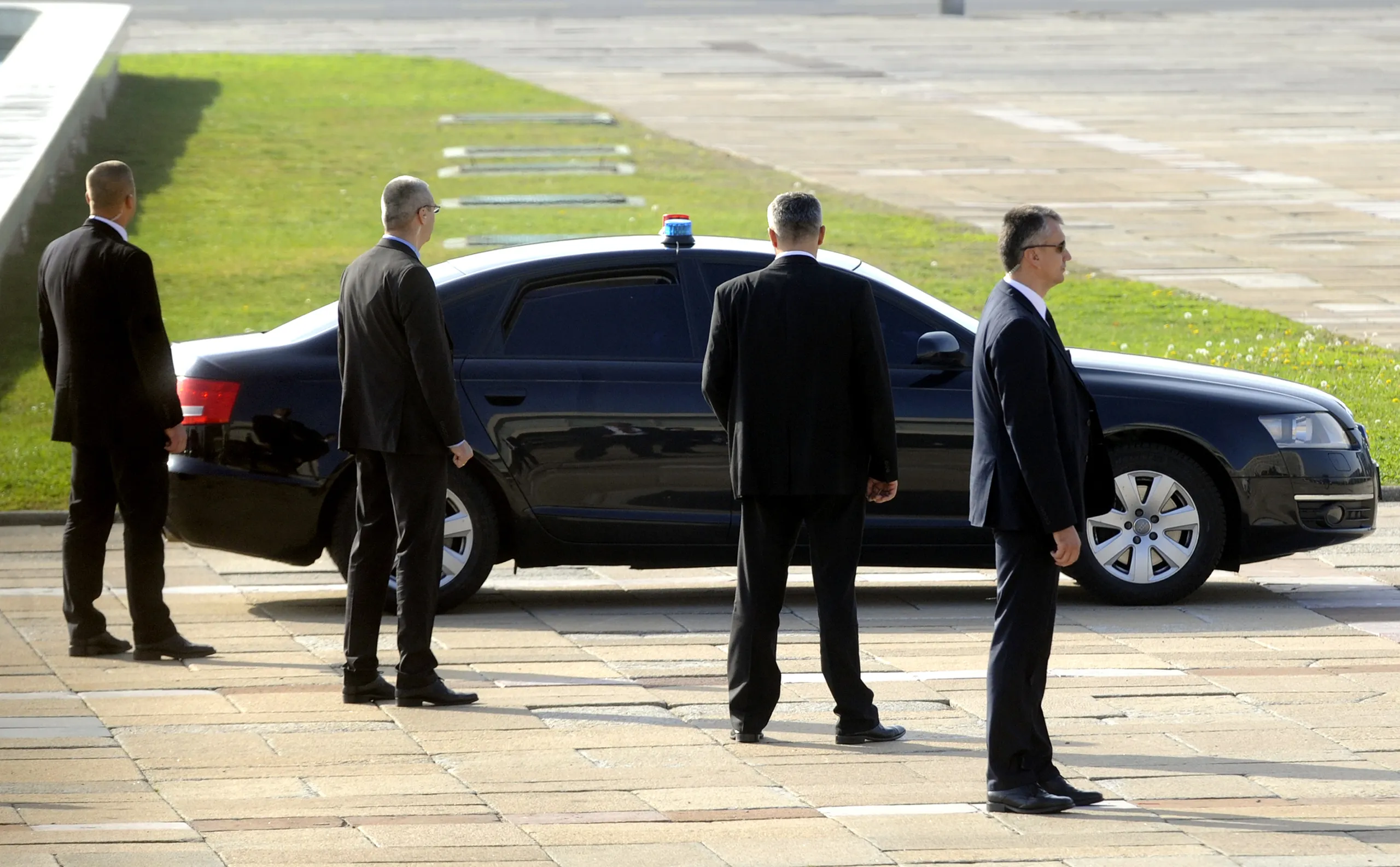
An EP programme in Conakry is built around the principal’s movement profile on the peninsula: airport transfers, government ministry meetings in Kaloum, corporate and embassy engagements in Dixinn, and any onward movement to mining sites in the Boke corridor. The team includes an armed CPO with the principal vehicle, advance work at all venues, and a documented emergency action plan covering medical emergency, vehicle compromise, and protest or civil disturbance.
The programme incorporates daily route variation to break predictability on the peninsula road, a confirmed medevac provider on retainer, and a first-aid-qualified team member as standard. Driver selection is built into the programme: Conakry drivers with working knowledge of secondary routes and neighbourhood access roads provide movement flexibility when the main artery is compromised.
For the full Conakry security picture, see our Conakry city briefing. For vetted secure transport alongside the EP team, security drivers in Conakry covers the Guinea driver programme.
For short-term, single-principal cover tied to one visit, see bodyguard hire in Conakry. For the operators who staff the programme and how they are vetted, see close protection officers in Conakry.
What does this cover in Conakry?
Licensing and Regulatory Framework in Guinea
Private security in Guinea is regulated by Decree D/2020/216/PRG of 26 August 2020, with authorisation from the Ministry of Security and Civil Protection (MSPC). Operators are required to register with the MSPC and ensure that personnel meet minimum vetting and training standards, though enforcement capacity is constrained by the country's limited institutional infrastructure. Following the September 2021 coup led by the CNRD (Conseil National du Rassemblement et du Developpement) under Colonel Mamadi Doumbouya, the regulatory environment has become less predictable: security sector reform is ongoing and operator relationships with state security entities require careful ongoing management. Clients should verify that their EP provider holds current MSPC registration, maintains documented vetting records for all personnel, and has an established working relationship with relevant ministry contacts under the transitional government. International operators working in Guinea typically partner with a local licensed company to ensure compliance and to maintain the access relationships that are essential for operating in a post-coup environment. Armed EP is available for high-risk principals through licensed operators, subject to MSPC authorisation.
Crime and Armed Robbery Risk
Conakry carries a well-documented armed robbery and carjacking risk, affecting both expatriate residents and transiting business principals. The UK FCDO does not advise against travel to Guinea, but its travel advice highlights the risks of street crime, including robbery with violence. Criminal actors in Conakry have targeted vehicles at traffic intersections, at poorly lit road sections on the peninsula, and in markets and commercial areas. Carjacking is most prevalent after dark and at predictable transition points such as hotel approaches and airport exits. EP teams counter these risks through consistent anti-surveillance, route variation, and avoidance of predictable patterns. The Kaloum peninsula, which houses the central business district and most government ministries, and the Dixinn zone, where many embassies and international organisations are located, are the primary operational areas for EP clients. Both zones require dynamic route planning given Conakry's chronically congested road network on the narrow peninsula. The post-coup political environment adds an additional dimension: public gatherings and political events have turned confrontational in Guinea's recent history, and EP programmes include monitoring and avoidance protocols for such situations.
Operational EP Protocols in Conakry
Conakry's geography presents a specific operational constraint: the city is built on a narrow peninsula approximately 36 kilometres long and 5 kilometres wide at its broadest point. The single main arterial road, Route Nationale 1, is the primary route for virtually all movements between the airport, the city centre, and the main residential and diplomatic zones. This creates predictability risk that EP teams must actively manage through timing variation, secondary routes where available, and pre-movement area checks. Ahmed Sekou Toure International Airport (CKY) is located at the northern tip of the peninsula, approximately 15 kilometres from central Conakry. Airport transfers are a high-exposure movement: the approach road has been the site of criminal incidents and requires advance coordination, confirmed pick-up protocols, and where warranted, an armed escort. EP programmes in Conakry typically include an armoured vehicle for the principal's movements given the carjacking risk. Driver selection is critical: local drivers with detailed knowledge of Conakry's secondary road network provide route flexibility that a non-local team cannot replicate. Advance work at hotels, offices, and meeting venues is conducted before each principal movement.
Mining Sector Context and Principal Profile
Guinea holds approximately one-third of the world's known bauxite reserves and significant gold deposits, making it a critical destination for mining sector principals from Australia, Canada, the UK, and China. The Boke bauxite corridor north of Conakry is a major operational hub for companies including Emirates Global Aluminium (EGA) through its Guinea Alumina Corporation project, and CBG (Compagnie des Bauxites de Guinee). Corporate executives, mine management, and project finance principals visiting Guinea typically base in Conakry before onward movement to site. The CNRD junta government has renegotiated several mining sector agreements since the 2021 coup, creating additional political risk for company representatives engaged in contract discussions with the transitional government. Kidnapping of mining sector personnel, while not frequent in Guinea, has occurred in the broader West Africa region, and EP programmes for mining principals incorporate counter-kidnap protocols alongside the standard CP programme. NGO and diplomatic principals also represent a significant client segment in Conakry, given Guinea's role as a host for UN agencies, the EU mission, and various bilateral development programmes.
Medical and Emergency Evacuation Planning
Guinea's medical infrastructure is severely limited. Conakry's public hospital system is under-resourced and not considered adequate for trauma or complex medical emergencies by international standards. The private clinic sector offers a modest improvement but remains constrained in its capability: Clinique Ambroise Pare (+224 621 35 35 35) is the best available private facility and handles routine care, though not complex trauma or specialist procedures. For any serious medical emergency affecting a principal, evacuation rather than local treatment is the planning assumption. The standard medevac destinations from Conakry are Dakar, Senegal (1 hour by air) and Casablanca, Morocco. Both have hospital facilities capable of managing trauma and complex cases. EP programmes operating in Conakry must have a medevac provider on retainer before the principal's arrival, with aircraft availability confirmed and the activation protocol documented in the emergency action plan. A first-aid-qualified CPO or dedicated medic embedded in the EP team is standard practice given the response time limitations of local emergency services. The EP programme's medical plan should name the receiving facility, the ground ambulance coordination contact at the airport, and the medevac provider's 24-hour operations line.
Sources for this page
Licensing, firearms and foreign-operator rules for Conakry, checked : Guinéenews, 'Guinée: nouvelle réglementation sur la sécurité privée (communiqué de presse)', 15 September 2020 (Ministry of Security and Civil Protection communiqué of 14 September 2020). The full rules are on our Conakry security overview.
Travel advice quoted on this page: FCDO travel advice: Guinea. Advice changes; read the current version before travel.
Frequently Asked Questions
Is armed executive protection available in Conakry?
How does the CNRD junta affect EP operations in Conakry?
What is the airport transfer risk at Conakry's Ahmed Sekou Toure Airport?
Where are medical cases evacuated to from Conakry?
Which zones in Conakry are relevant for EP client operations?
This page is published by CloseProtectionHire.com and written to editorial standards overseen by James Calloway, Senior Security Consultant (regulation, licensing, vetting and risk frameworks) and Marcus Webb, Security Operations Adviser (operational close protection, secure transport and city-specific safety).
Threat, regulatory and emergency information is sourced to named, dated authorities such as the FCDO, the US State Department and national licensing bodies. Last updated . See how we verify.