
Request an Event Security Quote for Tunis
Tunis hosts a significant volume of international corporate events and diplomatic gatherings, particularly in the Les Berges du Lac business district north of the city, which provides modern conference infrastructure with a lower street-level risk profile than the historic centre. Tunisia’s documented history of high-casualty terrorist attacks, including the 2015 Bardo Museum attack (22 killed) and the Sousse attack (38 killed), means terrorism-aware planning is a non-negotiable element of every Tunis event security operation. The political landscape following President Saied’s 2021-2022 consolidation of power creates an additional layer of institutional unpredictability, and civil unrest driven by economic pressure and IMF austerity has disrupted movement across the city on multiple occasions. For a fuller picture of the Tunis security environment, see our Tunis city security overview.
Event security in Tunis requires a clear separation between the recommended venue zones and the areas that carry elevated risk. Les Berges du Lac and the Carthage-La Marsa coastal corridor are the appropriate locations for international corporate gatherings, while the Medina, Bab El Khadra, and Bab Souika areas require detailed risk assessment before any event is planned there. All personnel show current licence documents, access control and credential verification are applied across all delegate access points, and secure transport from Tunis-Carthage International Airport is treated as a baseline for all international delegations. Our event security service overview describes how these elements are structured into a coordinated security plan for conferences and summits in medium-risk North African environments.
What does event security in Tunis cover?
Terrorism-Aware Venue Hardening
Tunisia has experienced high-casualty terrorist attacks: the 2015 Bardo Museum attack (22 killed), the Sousse beach attack (38 killed), and the Tunis Presidential Guard bombing. Venue hardening for all Tunis events incorporates these documented attack vectors, with particular attention to public access points, principal holding areas, and evacuation corridors.
Licensed Security Personnel
Private security in Tunisia, including the physical protection of persons, needs an authorisation under Law No. 2002-81 of 3 August 2002, and working without one is an offence (Article 32). Our Tunis panel engages only current licensed operators for guarding, access control, and close protection roles. Operator licence documentation is provided to clients as part of the pre-event confirmation pack.
District Risk Assessment and Venue Selection
Les Berges du Lac (Lac 1 and Lac 2), the modern business district north of the city, is the recommended zone for international corporate events, offering modern infrastructure and lower street-level exposure. The Medina, Bab El Khadra, and Bab Souika areas carry elevated risk and are not suitable for events involving international principals.
Political Instability Monitoring
President Saied's consolidation of power in 2021 and 2022 removed democratic checks and created a more unpredictable institutional environment. Civil unrest driven by economic pressure and IMF austerity measures adds a protest risk layer. Our operations team monitors political developments before and during each event, flagging escalations that may affect delegate movement or venue access.
Access Control and Credentialing
Multi-tier access management for conference properties in Les Berges du Lac, Carthage, and La Marsa, with credential verification, zone management, and real-time entry monitoring across all delegate and support access points. Advance liaison with in-house hotel security teams is completed before the event date.
Secure Delegate Transport
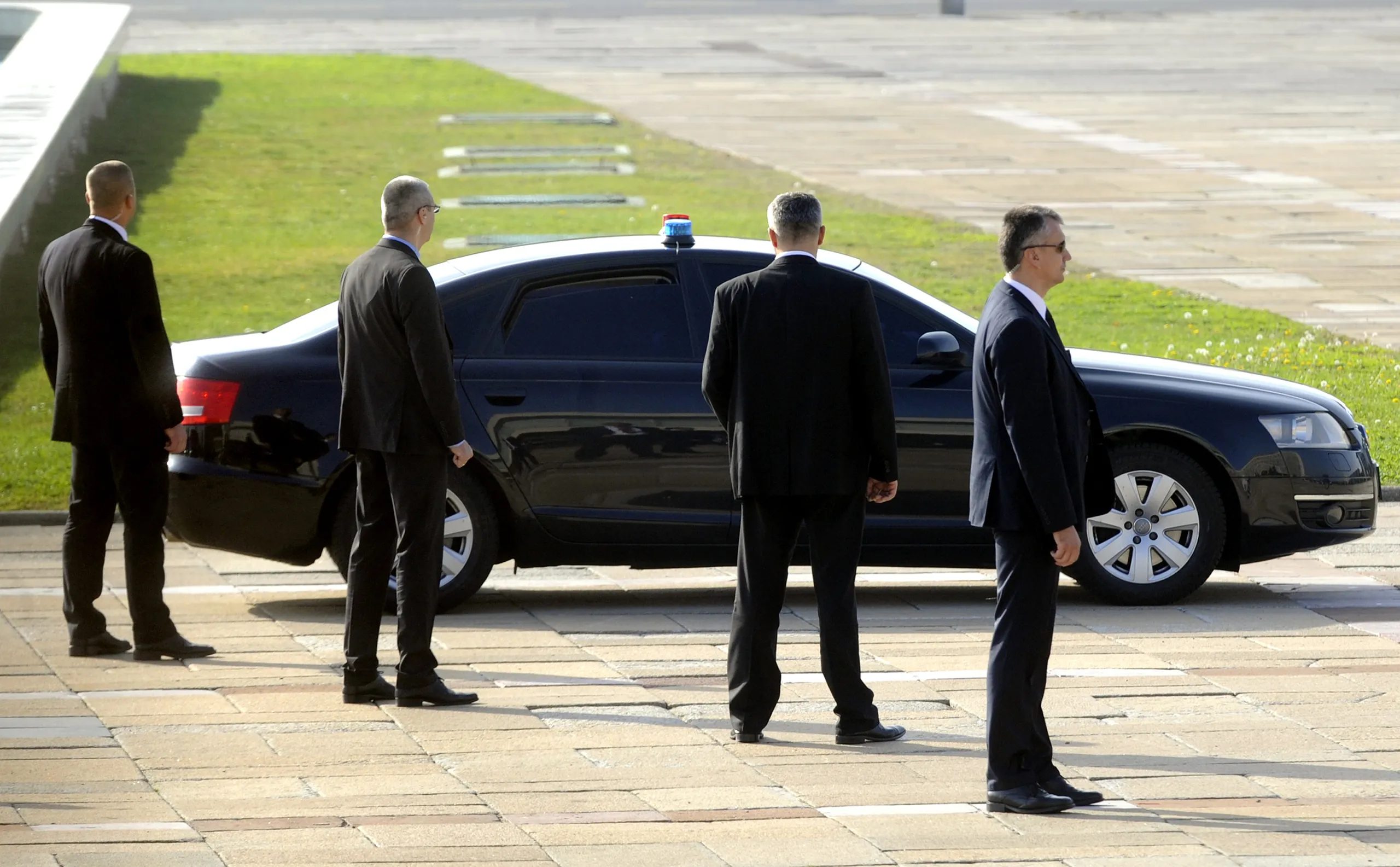
Vetted security drivers and vehicles for delegate movements between Tunis-Carthage International Airport and event venues, with terrorism-aware routing, operations controller monitoring, and contingency protocols for disrupted movement caused by civil unrest or checkpoint activity.
Vetted operators. Local knowledge. Proven protocols.
Sources for this page
Licensing, firearms and foreign-operator rules for Tunis, checked : Journal Officiel de la République Tunisienne No. 16 of 22 February 2008, pages 781 to 782: the law of 18 February 2008 amending Law No. 2002-81 of 3 August 2002 (new Articles 30 and 32; Article 4 repeals Articles 21 to 25), FAOLEX copy; UN Human Rights Council, Working Group on the use of mercenaries, A/HRC/27/50 (2014), paragraphs 20, 25 and 34: Tunisia's private security law and licensing by the ministry responsible for internal security. The full rules are on our Tunis security overview.
Travel advice quoted on this page: FCDO travel advice: Tunisia. Advice changes; read the current version before travel.