
Request an event security assessment for your Kinshasa delegation today.
Kinshasa’s cobalt, coltan and copper investment profile makes it an important destination for international mining conferences and African Development Bank regional meetings, but the FCDO DRC advisory highlights armed robbery, carjacking and political protest as persistent risks that require professionally managed event security across every aspect of the delegation’s stay. The Ministry of the Interior permit regime for guarding companies provides a regulatory structure for security providers, and the Grand Hotel Kinshasa and Fleuve Congo Hotel both provide a capable starting point for venue-based access control.
For the full Kinshasa security context, see our Kinshasa city page. Delegates requiring personal close protection at Kinshasa events should review bodyguard hire in Kinshasa for the licensed CPO programme.
What does event security in Kinshasa cover?
Kinshasa Event Landscape
Kinshasa is the commercial and political capital of the Democratic Republic of Congo, and its event calendar is driven primarily by the country's extraordinary mineral wealth. The DRC holds the world's largest cobalt reserves, substantial deposits of coltan, copper and gold, and significant untapped lithium potential, making Kinshasa a focal point for mining investment forums attended by executives from China, Australia, Canada, Europe and the Gulf states. The African Development Bank holds regional meetings in the capital, and SADC summits periodically bring heads of state and ministerial delegations to Kinshasa. The Grand Hotel Kinshasa and the Fleuve Congo Hotel are the principal international conference venues: both can accommodate several hundred delegates and have established security infrastructure. International NGOs and multilateral organisations maintain large Kinshasa operations, generating a continuous flow of coordination meetings and donor briefings. The delegate profile at commercial events is predominantly corporate, focused on extractive industry investment, project finance and supply chain logistics for battery minerals that are in global demand for the energy transition.
Ministry of the Interior Permit Framework
Guarding companies in the DRC need a Ministry of the Interior operating permit under Ministerial Order 25/CAB/MININTERSECDAC/037/2014, amended in November 2023, and in October 2026 the Ministry began inspecting guarding companies in Kinshasa. Private security companies may not hold or use firearms or patrol public roads. Enforcement remains uneven in practice. International clients should verify that their chosen provider holds a current Ministry of the Interior permit and can supply written documentation on request. The Forces Armees de la Republique Democratique du Congo (FARDC) and the Kinshasa Police Nationale play a role at high-profile government events, and coordination with official security forces is standard practice for ministerial-level gatherings. Events involving foreign dignitaries require advance notification to the protocol office of the Ministry of Interior.
Armed Robbery and Carjacking Risk
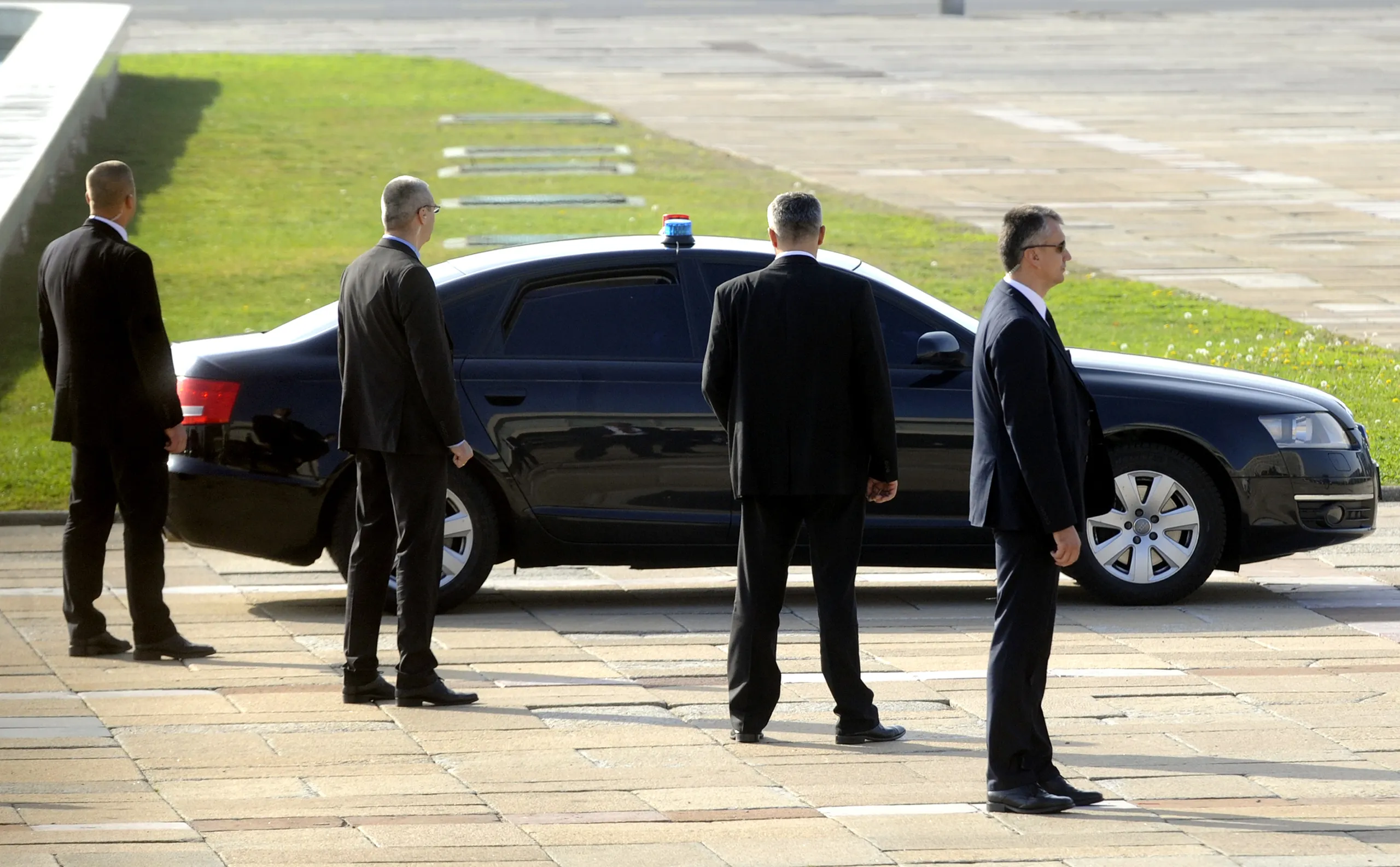
The FCDO DRC travel advisory rates Kinshasa as a high-risk environment for armed robbery, carjacking and mugging. Criminal networks target vehicles carrying foreign nationals, particularly in the approaches to the international conference hotel zone, near the airport and on major arterial roads during evening and night hours. Delegates should be briefed to avoid displaying expensive jewellery, watches, laptops or camera equipment in vehicles or on any kerb-side movement. Transfer vehicles should have tinted windows and should not feature any branding or insignia that identifies them as carrying foreign delegations. All vehicle doors should remain locked throughout transfer legs. In the event of an attempted carjack, the primary instruction to delegates is compliance: the security team manages the response; delegates should follow instructions immediately. Route variation across multi-day events is operationally important: predictable routes invite surveillance by criminal elements. The event security team should maintain a current assessment of active criminal hotspots through a local liaison network.
Venue Access Control
The Grand Hotel Kinshasa and the Fleuve Congo Hotel operate vehicle screening and perimeter security, but these are general hotel-standard measures and not calibrated to the specific risk profile of an international conference. The event security team must establish a dedicated credentialling process separate from the hotel's standard front-of-house operation, using photo identification verified against a pre-registered delegate list. VIP and ministerial delegates should use a secured arrival route that bypasses the main hotel entrance. Catering, technical and AV contractors must be verified against a pre-approved list and issued with event-specific passes distinguishable from hotel staff. A sweep of the session room and all adjacent areas must be completed before the first delegate arrives each day. Communications between the access control supervisor and the event security command must run on a dedicated encrypted channel. Political protest risk should be factored into venue selection and movement planning: the Tshisekedi government context has seen periodic public demonstrations in central Kinshasa that can affect access routes.
FIH Airport Delegate Transfer Management
N'Djili International Airport (FIH) is Kinshasa's international airport, located approximately 25 kilometres east of the city centre. The arrivals terminal is a congested environment with limited controlled space, and the airport road approach is one of the higher-risk transfer corridors in the city. Inside-terminal collection is the standard protocol: the meet-and-greet officer positions as close to the arrivals exit as access permits, and transfer vehicles are pre-positioned in the designated secure vehicle area within the airport compound. The road between FIH and the hotel zone in Gombe district passes through several areas where vehicle approaches and roadside robbery have been recorded. All transfer vehicles should maintain a live communications link to the event security command throughout the transfer leg. Night arrivals carry significantly elevated risk: daytime arrivals are strongly preferable for international delegations. Vehicle selection should favour locally registered estate cars or SUVs without foreign-company branding. Delegates should be briefed before landing on the collection protocol and on the instruction to remain with the security-managed vehicle under all circumstances.
Political Context and Medical Infrastructure
The DRC is a country of significant political complexity: the Tshisekedi government's second term follows disputed election processes, eastern DRC continues to experience active armed conflict involving M23 and FDLR rebel forces (which does not directly affect Kinshasa but shapes the political temperature), and public frustration over governance and service delivery has produced periodic demonstrations in the capital. Event security teams must monitor the political calendar and build contingency movement plans that avoid demonstration flashpoints, particularly in central Kinshasa and near government ministry buildings. Medical infrastructure in Kinshasa is below international standards for complex emergency care. Private facilities including the Ngaliema Medical Center in Kintambo and the Centre Medical de Kinshasa provide a better baseline than public hospitals, but the FCDO records that for serious cases medical evacuation to South Africa or elsewhere could be necessary. All delegates must hold insurance covering emergency medical evacuation, and a medevac provider must be on standby for the event duration.
Vetted operators. Local knowledge. Proven protocols.
Sources for this page
Licensing, firearms and foreign-operator rules for Kinshasa, checked : AFREWATCH study on private security companies and human rights in the DRC (June 2021), pages 9 to 12 and 29: Ministerial Order 25/CAB/MININTERSECDAC/037/2014, the Ministry of the Interior register and the use of police and armed forces; Leganews, Ministerial Order 25/CAB/VPM/MININTERSECAC/PKK/243/2023 of 14 November 2023 amending the 2014 order on the conditions for operating guarding companies (title and summary); Radio Okapi via allAfrica, 20 July 2026: Haut-Katanga police remind private security companies that they may not hold or use firearms; Agence Congolaise de Presse, 2 October 2026: Ministry of the Interior inspections of guarding companies in Kinshasa; Agence Congolaise de Presse, 3 July 2026: civilian firearms governed by Ordonnance-loi 85-035 of 3 September 1985. The full rules are on our Kinshasa security overview.
Travel advice quoted on this page: FCDO travel advice: Democratic Republic of the Congo. Advice changes; read the current version before travel.