Security Intelligence
Security for Film and Television Production | CloseProtectionHire
Security for film and TV productions shooting in high-risk locations. Talent close protection, location advance work, night shoot protocols, and equipment security in P1 cities.
Written by James Whitfield, Senior Security Consultant
Security for Film and Television Production
Film and television productions routinely operate in locations that would trigger a travel risk assessment for a corporate traveller. The difference is that a production company has limited ability to choose its shooting environment based on security considerations alone – the story, the locations, the budget, and the schedule drive those decisions. The security function has to work within those constraints, not around them.
This guide covers the security framework for productions shooting in high-risk locations: the duties that fall on production companies, the specific risks that apply to talent close protection in a film environment, the night shoot problem, equipment security, and the particular challenges of shooting in P1 cities.
Production Company Duty of Care
Under the Health and Safety at Work Act 1974, every employer – including a production company – has a duty to ensure the health, safety, and welfare of employees so far as is reasonably practicable. This duty extends to cast and crew whether they are employees, contractors, or freelancers working under the production’s direction.
The Rust incident of 21 October 2021, in which cinematographer Halyna Hutchins was killed on the Bonanza Creek Ranch set in New Mexico, made the liability dimension concrete. The production company settled with Hutchins’ family for USD 6.5 million. Armorer Hannah Gutierrez-Reed was convicted of involuntary manslaughter and sentenced to 18 months in 2024. New Mexico enacted the nation’s first mandatory on-set firearms safety legislation in 2022. Whatever the specific cause of any given incident, the legal message for production companies is unambiguous: you are responsible for on-set safety, and you will be held accountable (New Mexico HB 116, 2022).
Security on a production is not a standalone function. It integrates with health and safety, with the assistant director’s logistics management, with the location manager’s advance work, and with the insurance broker’s risk requirements. APA (Association of Producers and Agents) and PACT (Producers Alliance for Cinema and Television) both reference security requirements in their production insurance frameworks, particularly for overseas shoots in elevated-risk environments.
Location Advance Work
The location manager conducts a recce to identify shooting logistics, permits, and local authority requirements. The security advance is a distinct but parallel function that should happen on the same visit or a dedicated separate trip.
A security advance for a location shoot covers:
Approach and departure routes for talent vehicles. What is the primary route from the hotel or base camp to the location? Are there alternative routes if the primary is compromised – by crowd, by protest, by traffic incident? Where are the nearest safe havens if an evacuation is needed mid-journey?
Proximity threats at the specific location. What is the character of the immediate area? Is the location in a neighbourhood with elevated petty crime or organised theft activity? Have there been incidents at this type of location in this city before? The OSAC and FCDO country advisories, combined with local intelligence from an in-country security partner, answer these questions.
Crowd management requirements. Will the shoot attract a crowd? How large? What is the permit situation? Is police presence required and available? Lagos, Mumbai, Istanbul, and Manila are all cities where a major production shooting in a public space can attract crowds that create management challenges without adequate advance planning.
Emergency evacuation routing. If an incident occurs during the shoot, how does the company evacuate cast and crew? What is the nearest medical facility? Is there a hospital with appropriate capability for a foreign national, and is it on the production’s insurance panel?
Equipment staging security. Where will high-value equipment be stored overnight and between setup and wrap? Is the space alarmed, locked, and access-controlled?
Talent Close Protection on a Film Set
A CPO providing close protection for a high-profile actor or director on a film set operates in a managed environment that differs from most executive protection contexts.
Access to a film set is already controlled. The production’s accreditation system – passes, wristbands, closed perimeter – means the CPO is not managing a public environment. The role shifts to personal protection within a relatively controlled site, with specific risks:
Fixated individuals. High-profile productions attract people attempting access for autographs, photography, or more concerning purposes. The production’s access control is the first line; the CPO is the last. Clear briefing of all gate staff on access protocols, and a fast-response escalation chain when access attempts occur, is the framework.
Paparazzi at location shoots. Public location shoots – in city streets, public parks, transport hubs – cannot be fully sealed. Long-lens photography from outside the perimeter is legal. What is not acceptable is access to the principal in transit, or behaviour that creates a safety risk. Route pre-planning and departure timing variation reduce paparazzi exposure.
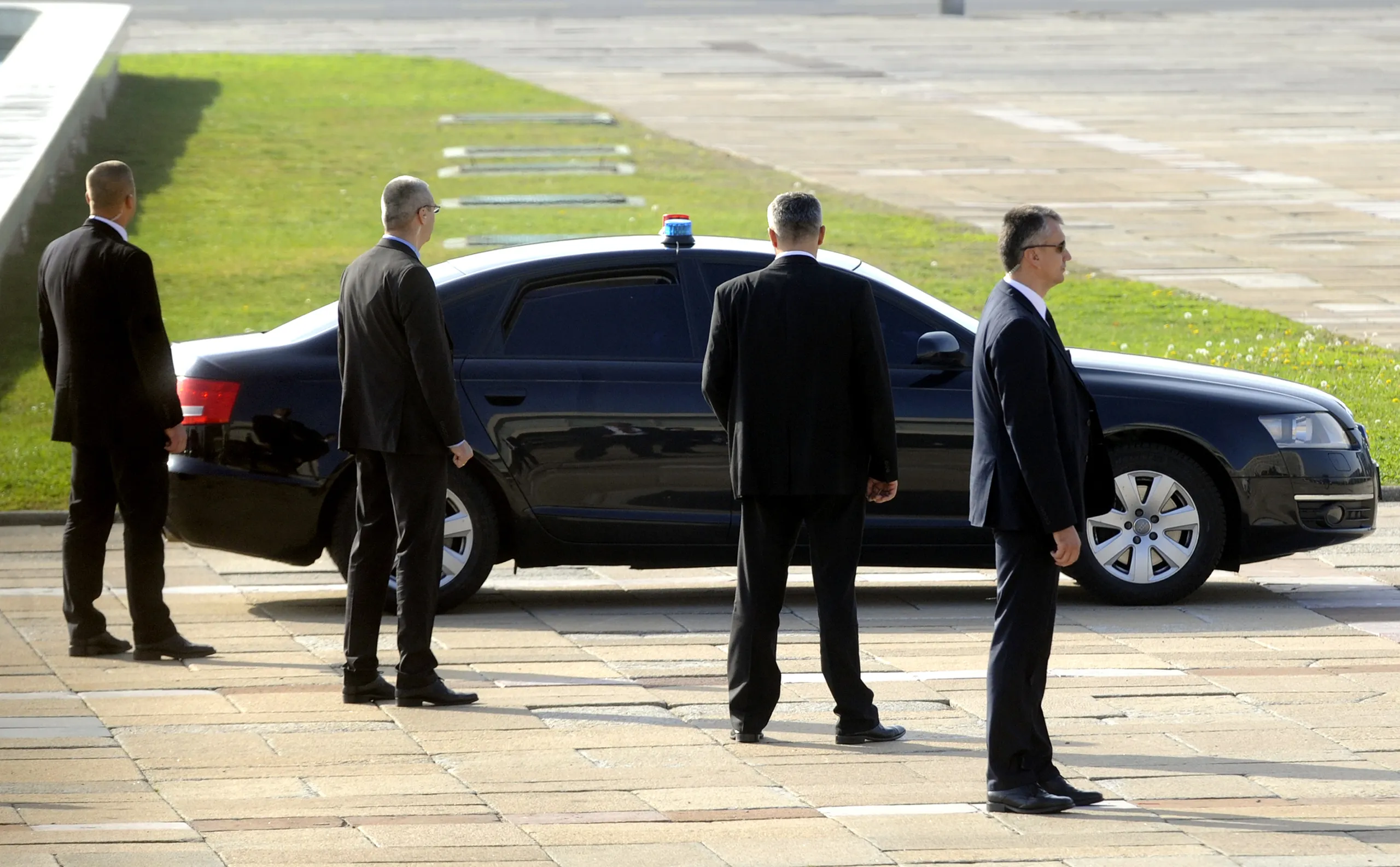
The departure phase. The most significant risk window on a film set is not during the shoot itself – it is when the principal moves from set to transport to hotel, often at unpredictable times after a long day. This is when paparazzi converge, when fan activity is highest, and when fatigue in the security team is greatest. Departure protocols – pre-positioned vehicle, no announced departure time, varied routes – are the primary mitigation.
Covert operation is typically required on set. A uniformed close protection officer visible during a take is a continuity problem. A CPO who is obviously present changes the social dynamic for the principal’s interactions. The default is low-profile integration with the crew. The visible transition to a more active posture happens at wrap, in transport, and on arrival at the accommodation.
For the broader framework on close protection for high-profile individuals, see our guide to security for celebrities, athletes and entertainers.
Night Shoots in P1 Cities
Night shoots create a specific and recurring problem. The production is in a part of the city selected for its aesthetic or logistical value – which often means a less commercially active, less well-lit, and less police-patrolled area. The crew is reduced to essential personnel. Fatigue is a factor from the third night onwards. High-value equipment is being moved in darkness. Transport is operating on skeleton logistics.
In P1 cities, this combination produces elevated risk. Lagos night shoots on location have documented equipment theft histories. Istanbul night shoots in peripheral areas – away from the tourist corridors – require a different security posture than daytime central city shooting. Manila night shoots in Makati or Quezon City carry different risks from night shoots in less controlled districts.
The mitigations:
Pre-arranged secure transport for all talent and key crew, with vetted drivers from a vetted local provider – not hotel taxis and not driver-sharing apps. A dedicated security presence at the equipment staging area throughout the night. A check-in schedule for all crew with a designated safety officer. A clear protocol for the end of the night: how does everyone get back, in what order, and who confirms arrival?
Equipment Security
Professional camera packages, drone rigs, and lighting arrays used on major productions routinely have replacement values exceeding GBP 100,000. That value makes them a target in cities with organised theft activity.
The highest-risk moment for equipment is transit – between locations, between production days, at the end of a shoot before equipment is packed for return. Organised theft groups in several P1 cities have targeting patterns specifically for production equipment: Lagos vehicle raids on location transport, opportunistic theft at staging areas in Manila and Mexico City.
Standard equipment security measures:
A chain-of-custody log for all items above a specified value threshold. Locked, alarmed cases for high-value items with tamper-evident seals. A dedicated equipment custodian who is accountable for the log. Alarmed and access-controlled overnight storage. TAPA FSR-standard transport for high-value equipment in elevated-risk environments – a tracked vehicle with locked compartments and a driver who does not stop en route except at pre-planned locations.
Production insurance underwriters – including the major UK and US providers in the APA/PACT sphere – ask directly about security procedures for equipment in high-risk locations. A documented security plan reduces premium risk and, more importantly, reduces the chance of a production shutdown due to stolen equipment.
P1 City Shooting Environments
The fifteen P1 cities that drive the most enquiries for production security present a range of challenges:
Lagos has the largest film industry in Africa by volume (Nollywood produces over 2,500 films per year) and a functioning ecosystem of local production security providers. The challenge for international co-productions is integration: a Western production security framework and a Lagos production environment need careful alignment on protocols, communications, and authority structures.
Istanbul is a major production hub for European and US streamers, with physical infrastructure and experienced local crews. The security challenge is primarily around high-profile international talent visiting sites that attract public attention, and around digital surveillance awareness for crew in a market with active intelligence monitoring of foreign visitors.
Bangkok has hosted dozens of major international productions. The city’s tolerance for location shooting is high, the production infrastructure is developed, and the security environment is manageable. The specific risks are for crew operating in non-tourist areas of the city at night.
Mumbai presents the familiar challenge of public space shooting in a dense metropolitan environment where a recognisable cast member can attract a crowd within minutes. Advance crowd management planning is not optional.
Manila requires careful location selection. BGC (Bonifacio Global City) and Makati provide controlled shooting environments. Outside those areas, advance work and in-country security liaison are essential.
For the advance work methodology that underpins all location security planning, see our guide to event security planning.
Key takeaways
Location advance work is standard CP methodology applied to film
The location manager's recce identifies shooting logistics. The security advance identifies risks. These are separate functions that require coordination. An advance for a location shoot in Lagos, Istanbul, or Bangkok should cover approach and departure routes for talent vehicles, proximity threats at the specific location, local crowd management requirements, and emergency evacuation routing -- before the crew arrives.
Night shoots in P1 cities require dedicated transport security
Shooting at night in P1 cities creates a predictable problem. Crew are tired, numbers are reduced, the location is often in a less-controlled part of the city chosen for aesthetic reasons, and vehicle logistics operate in the dark. Pre-arranged secure transport with vetted drivers for all talent and night crew is the minimum standard. High-value equipment should not leave the location without a security escort.
Talent CP operates differently in a production environment
A CPO on a film set is not a uniformed guard at the gate. They integrate with the production structure, operate within the access control system the AD team runs, and provide personal protection without disrupting the creative environment. Covert or low-profile operation is the default. The departure phase -- transport from set to hotel -- is typically where the visible close protection function is most needed.
Equipment theft is the most frequent security loss on location shoots
High-value camera and production equipment is targeted by organised theft groups in several P1 city shooting environments. Lagos, Manila, and Mexico City have documented patterns of equipment theft from unsecured production vehicles and staging areas. A chain-of-custody log, alarmed storage, and a dedicated custodian are the basics. For high-value items, TAPA-standard locked cases and tracked vehicles should be specified.
Crowd management at public location shoots requires local authority liaison
Public location shoots attract crowds. In P1 cities, crowd management without adequate advance liaison with local police or private security can deteriorate quickly. The location manager's permit process should include a security annex that specifies crowd management requirements. In cities where productions have run into crowd issues -- Nollywood shoots in Lagos, major productions in Mumbai -- the pattern is consistent: underprepared crowd management and no security liaison.
Frequently Asked Questions
Request a Consultation
Describe your security requirements below. All enquiries are confidential and handled by licensed consultants.
Your enquiry has been received. A security consultant will contact you within 24 hours to discuss your requirements.